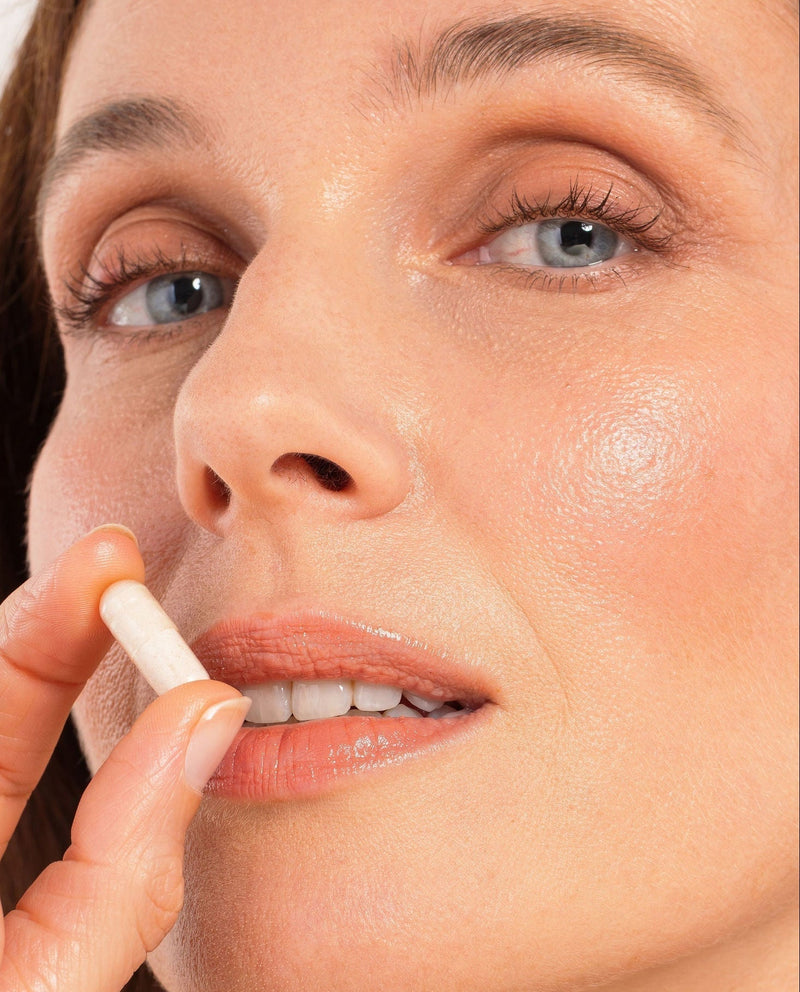

- Marine, bovine and eggshell membrane are not three interchangeable versions of the same ingredient.
- For collagen hydrolysates, process, peptide profile, dose and studies on the specific material matter just as much as the animal source.
- Eggshell membrane is a naturally complex matrix. Its doses cannot be compared gram for gram with a collagen hydrolysate.
Collagen has managed a fairly unusual feat: turning a formulation question into a battle of origins.
Marine or bovine?
The first is often presented as finer, more premium, almost more elegant. The second as more conventional.
Then eggshell membrane arrives, with a few hundred milligrams where other products talk in grams.
At that point, the comparison becomes distinctly shaky.
Source matters, but it only tells the beginning of the story
Collagens are a family of proteins. The starting tissues do not have exactly the same composition.
But in a hydrolysed supplement, a second step substantially changes the material: hydrolysis breaks large proteins down into smaller peptides.
Two marine collagens can therefore be very different depending on the process, enzymes, molecular-weight profile and final characterisation.
“Marine” is not a recipe. Neither is “bovine”.
Fish, bovine, egg: important information for sourcing, allergens and preferences.
Process, profile, dose, traceability and clinical data still need to be examined.
Marine: real data, not universal superiority
Human trials exist on certain fish-derived collagen peptides and report favourable results across several skin parameters.
That is a good reason to take those materials seriously.
It is not proof that every marine collagen is superior to every bovine collagen.
A positive study first supports the material actually tested, at the dose actually tested.
Bovine: less exotic does not mean less interesting
Bovine collagen is often derived from skin or connective tissues and mainly contains types I and III collagen.
It is longstanding and widely used, which can make it less “desirable” in marketing narratives.
But a well-characterised, well-controlled and directly studied bovine hydrolysate can be far more convincing than a marine one chosen only because the word sounds better.
And absorption? A recent study calms the competition a little
In 2024, a crossover study in volunteers compared several hydrolysates derived from fish skin, porcine and bovine sources.
The researchers measured free hydroxyproline, peptide-bound hydroxyproline and several circulating peptides after ingestion.
Absorption of free hydroxyproline was comparable across the sources tested, with differences in certain circulating peptides. All materials also led to measurable plasma concentrations of the metabolites studied.
The argument “marine = necessarily better absorbed” is far too simple. Origin can influence the final profile, but on its own it cannot rank bioavailability or efficacy.
Eggshell membrane changes category
The membrane is the thin layer between the shell and the egg white.
It naturally contains several components of the extracellular matrix, including collagens, elastin, hyaluronic acid and glycosaminoglycans.
In other words, it is not simply a third animal source from which a large amount of collagen has been extracted and hydrolysed.
It is a complex biological matrix.
Why are the doses so much smaller?
Collagen hydrolysates are often studied at 1 g, 2.5 g, 5 g or more per day.
Eggshell-membrane ingredients have been studied at a few hundred milligrams.
The temptation is immediate: to say that 300 mg of membrane “equals” several grams of collagen.
We would not make that equivalence.
The ingredients are not identical. Their composition and study protocols differ. A smaller dose is not proof of greater potency.
At Eclo: what Reggenerate™ is, and what it is not
Our Collagen formula uses 300 mg of Reggenerate™, an eggshell-membrane material developed in France by Circul'Egg.
The manufacturer describes a 100% mechanical process, with no added chemicals, to separate and upcycle the eggshell membrane.
We therefore talk about 300 mg of Reggenerate™, not “300 mg of pure collagen”.
And we keep another boundary very clear: trials exist on Ovoderm, MKARE® and other proprietary membranes. They help inform the category, but they are not trials of Reggenerate™.
Turn a study conducted on another membrane into clinical proof for Reggenerate™, or claim that a membrane dose is equivalent to several grams of hydrolysate without a direct comparison.
Sustainability can also be part of the choice
Eggshell membrane is a co-product of the food industry. Recovering and upcycling it can fit into a circular approach.
That is a genuine formulation argument for Eclo, provided it is not confused with evidence of efficacy.
An ingredient can be interesting for its composition, dosage form, sourcing and environmental profile. Those qualities can coexist without becoming the same thing.
The right comparison grid
So which one is “best”?
Probably none by definition.
There are mainly good and poor materials, coherent or decorative doses, and evidence that is more or less directly connected to the product.
Source matters. But it is not a ranking.
Origin is a characteristic. Quality is a complete dossier.
A matrix, not a marine-versus-bovine battle.
Collagen uses 300 mg of Reggenerate™ with 60 mg of vitamin C. Régénère™ also incorporates this material into a broader formula. We choose it for what it is, not to claim it “equals” every other collagen.
Discover CollagenSources
Virgilio N. et al. (2024). Absorption of bioactive peptides following collagen hydrolysate intake: a randomized, double-blind crossover study in healthy individuals.
PubMed, PMID 39149544
Evans M. et al. (2021). A randomized, triple-blind, placebo-controlled, parallel study to evaluate the efficacy of a freshwater marine collagen on skin wrinkles and elasticity. Journal of Cosmetic Dermatology.
PubMed, PMID 32799362
Aguirre A. et al. (2017). Beneficial Effects of Oral Supplementation With Ovoderm on Human Skin Physiology: Two Pilot Studies. Journal of Dietary Supplements.
PubMed, PMID 28429999
Kalman D.S., Hewlings S. (2020). The effect of oral hydrolyzed eggshell membrane on the appearance of hair, skin, and nails in healthy middle-aged adults: A randomized double-blind placebo-controlled clinical trial. Journal of Cosmetic Dermatology.
PubMed, PMID 31904175
Circul'Egg, official Reggenerate™ documentation.
Supplier documentation