
- Collagen and hyaluronic acid coexist in the skin matrix, but they do not play the same role there.
- Combining them makes biological sense. That alone is not enough to demonstrate clinical synergy.
- A 2024 trial compared collagen + vitamin C with the same formula plus added HA: the HA did not provide a significant additional benefit on the parameters studied.
Collagen + hyaluronic acid.
On a box, the combination looks almost impossible to criticise.
One suggests structure. The other hydration. Together, we immediately picture skin that has figured everything out.
Biologically, the idea makes sense.
But “coherent” and “superior” are not the same word.
In the skin, they do not do the same job
Collagen is a major structural protein of the dermis.
Hyaluronic acid is a glycosaminoglycan that contributes, among other things, to the water-rich and viscoelastic environment of the extracellular matrix.
They therefore belong to the same landscape without being interchangeable.
A family of proteins that contributes to the mechanical architecture of the dermis.
A glycosaminoglycan whose behaviour depends in part on its molecular weight.
That is a good reason to study the combination.
Not yet a reason to write “synergy”.
Why intuitive logic can be misleading
One ingredient can already influence several elements of the matrix.
In work published in 2015, collagen peptides were associated with changes in several skin parameters in humans, and ex vivo models also showed stimulation of glycosaminoglycans.
The real world is therefore less tidy than our “collagen = structure, HA = water” diagram.
Adding both can make sense, but biological pathways overlap.
Complementarity = two coherent roles. Synergy = the combination performs better than we would expect from the ingredients separately. The second word requires much more evidence.
In 2024, a study asked exactly the right question
A randomised, double-blind, placebo-controlled trial compared three groups over 16 weeks:
placebo;
5 g of hydrolysed collagen + 80 mg of vitamin C;
the same formula + 30 mg of hyaluronic acid.
Both active formulas improved certain parameters such as dermal density and texture.
But adding 30 mg of HA did not demonstrate a significant additional benefit compared with collagen + vitamin C on the outcomes studied.
Does that mean the combination is useless?
No.
This study tests 30 mg of a specific HA in a specific formula, in a specific population.
Other doses or materials could produce different results.
But until that is demonstrated, the accurate sentence remains the longer and slightly less glamorous one: in this trial, adding 30 mg of HA did not provide a significant additional benefit.
The dose changes the comparison enormously
Trials of oral HA alone often use 120 mg per day. ExceptionHYAL® Star has been evaluated at 200 mg per day in a published trial.
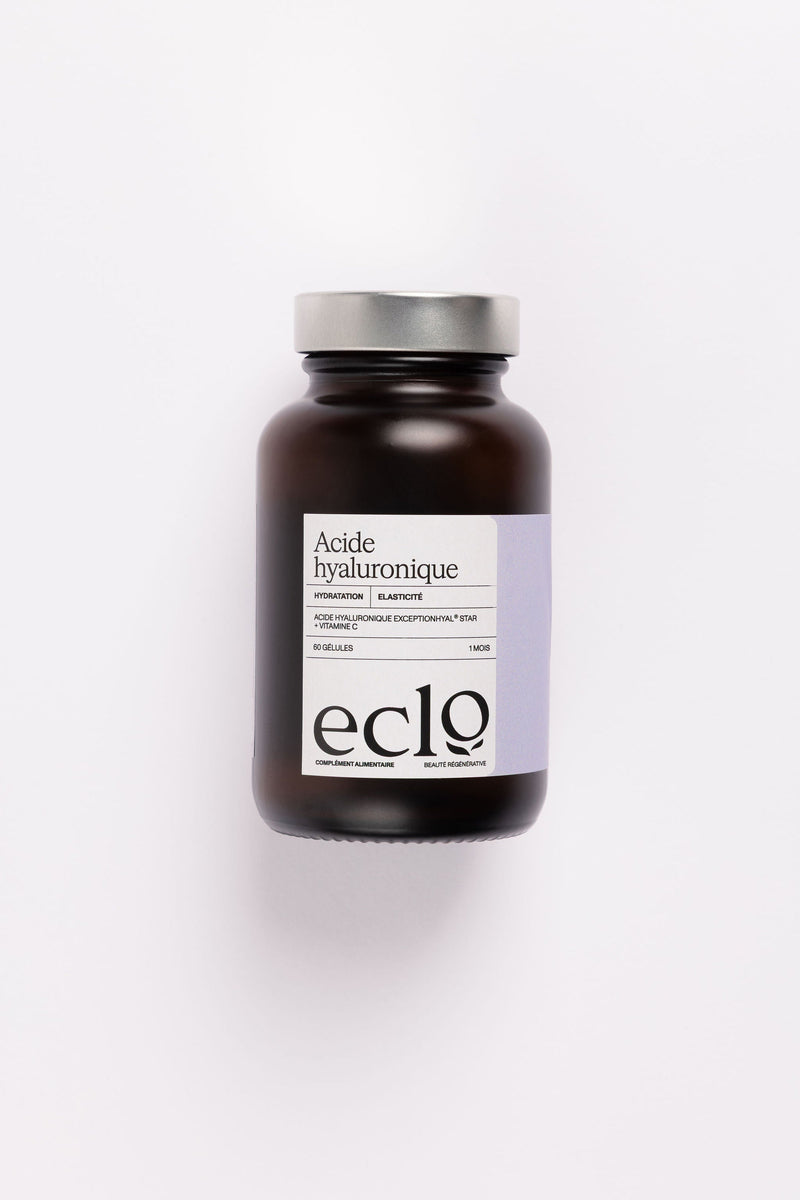
At Eclo, our Hyaluronic Acid 200 mg formula contains 224.8 mg of ExceptionHYAL® Star to provide 200 mg of hyaluronic acid.
Comparing these 200 mg with the 30 mg used in the combination trial only makes sense if we keep the contexts separate.
What about eggshell membrane? A third situation again
Our Collagen formula uses 300 mg of Reggenerate™, an eggshell-membrane matrix that naturally contains several components, including collagen, elastin, hyaluronic acid and glycosaminoglycans.
That is not the same as a collagen hydrolysate to which a separate dose of HA is added.
And the natural coexistence of several components still does not demonstrate clinical synergy.
Three products can therefore say “collagen + HA” and be completely different
Our checklist before believing in the “perfect duo”
Complementarity is an excellent reason to formulate. It is not automatic proof of synergy.
Targeted collagen or precisely dosed hyaluronic acid?
At Eclo, Collagen is built around an eggshell-membrane matrix. Hyaluronic Acid 200 mg is built around ExceptionHYAL® Star. The fact that they meet in biology does not make them redundant.
Take my diagnosticSources
Žmitek K. et al. (2024). The Effects of Dietary Supplementation with Collagen and Vitamin C and Their Combination with Hyaluronic Acid.
PubMed, PMID 38931263
Asserin J. et al. (2015). The effect of oral collagen peptide supplementation on skin moisture and the dermal collagen network.
PubMed, PMID 26362110
Amin P. et al. (2025). PubMed, PMID 40911749
Circul'Egg, Reggenerate™ documentation.
View the documentation
ROELMI HPC, ExceptionHYAL® Star documentation.
View the documentation