
- There is no universal course length. The right timeframe depends on the material, the dose and, above all, the outcome you are trying to measure.
- A 12-week study does not mean the product “starts working” at exactly 12 weeks. You need to look at when measurements were actually taken.
- Some changes are objective but imperceptible. How you feel is therefore not always the right stopwatch.
“How long before I see something?”
It is probably the most normal question when you start taking a supplement.
And the most common answer often sounds like: “three months”.
Three months is a very convenient duration. Long enough to sound serious, short enough to sell as a course.
Biologically, there is nothing universal about it.
Study duration is not the same as time to effect
If a study lasts twelve weeks, several scenarios are possible.
The researchers may have measured outcomes at weeks 4, 8 and 12. Or only at the beginning and the end.
In the second case, a change seen at twelve weeks could have begun much earlier. We simply do not know.
Marketing likes to turn “measured at 12 weeks” into “works in 12 weeks”. It is cleaner. It is sometimes wrong.
Whenever a timeframe is quoted, ask: which outcome actually changed at that point?
Collagen shows that every parameter has its own clock
In trials of collagen peptides, dermal density, network fragmentation, hydration and elasticity do not necessarily change at the same time.
A 2015 study reported some structural changes from four weeks, while improved hydration was observed later.
Another trial measured elasticity after four and eight weeks, and again after supplementation stopped.
So there is no single “collagen day” when every needle suddenly moves into the green.
Hyaluronic acid illustrates the difference between materials
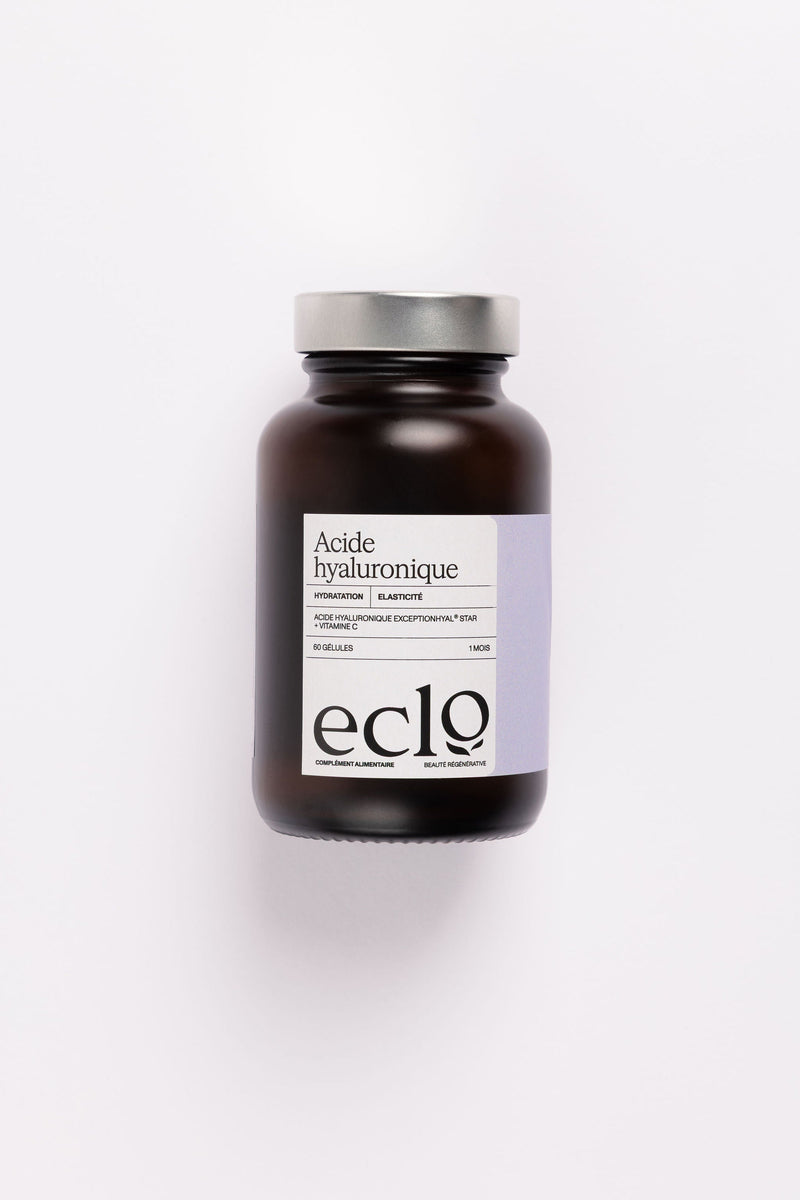
The published trial of ExceptionHYAL® Star evaluated 200 mg per day of full-spectrum hyaluronan for 28 days in 60 women.
Other trials of other hyaluronic acids have lasted 6 or 12 weeks.
That is not a contradiction. The materials, doses, populations and endpoints differ.
At Eclo, Hyaluronic Acid 200 mg uses 224.8 mg of ExceptionHYAL® Star to provide 200 mg of hyaluronic acid.
We can therefore connect the material to its published protocol. We cannot turn 28 days into a universal rule for every HA.
Omega-3 shows why “I feel nothing” does not mean “nothing is changing”
EPA and DHA can gradually become incorporated into red-blood-cell membranes.
That change can be measured. It does not necessarily produce a recognisable sensation on a Tuesday morning.
The body has the frustrating habit of not sending a notification for every biological change.
For some supplements, the right outcome is therefore a biomarker or an instrumental measurement, not simply how you feel.
Very important for some goals, but sensitive to context and placebo effects.
A biomarker, instrument or standardised score depending on the question.
What about magnesium for sleep? Be careful with extrapolation
A randomised trial published in 2025 evaluated 250 mg of elemental magnesium as bisglycinate for four weeks in 155 adults reporting poor sleep quality.
The difference in insomnia score was statistically favourable but small.
This does not mean “bisglycinate works in four weeks” for every product.
And importantly, it is not evidence for Ressource™, which provides 56.25 mg of elemental magnesium per daily dose, a very different amount within a multi-active formula.
Your starting point matters too
A supplement never enters a neutral body.
Dietary intake, baseline status, age, diet, medication, sleep and other factors can all influence the response.
Someone with an insufficient intake may not respond in the same way as someone who is already adequately supplied.
That is another reason why copying the calendar from a study without looking at its participants is misleading.
Six questions before deciding “it works” or “it does not work”
Three months is therefore neither too long nor too short by definition
For some objectives, three months may be perfectly coherent.
For others, data exist at four weeks. For others still, the marker continues to change beyond that.
The duration should follow the scientific question, not commercial habit.
The right time to judge a supplement is when the relevant outcome has had a reasonable chance to change, based on data for the material actually used.
A timeframe should be tied to data.
We prefer to explain the windows observed in studies of each material rather than promise a universal stopwatch. And when the finished formula itself has not been studied, we say so.
Find my routineSources
Asserin J. et al. (2015). The effect of oral collagen peptide supplementation on skin moisture and the dermal collagen network: evidence from an ex vivo model and randomized, placebo-controlled clinical trials. Journal of Cosmetic Dermatology.
PubMed, PMID 26362110
Proksch E. et al. (2014). Oral supplementation of specific collagen peptides has beneficial effects on human skin physiology: a double-blind, placebo-controlled study. Skin Pharmacology and Physiology.
PubMed, PMID 23949208
Michelotti A. et al. (2021). Oral intake of a new full-spectrum hyaluronan improves skin profilometry and ageing: a randomized, double-blind, placebo-controlled clinical trial. European Journal of Dermatology.
PubMed, PMID 34933842
Cao J. et al. (2006). Incorporation and clearance of omega-3 fatty acids in erythrocyte membranes and plasma phospholipids. Clinical Chemistry.
PubMed, PMID 17053155
Schuster J. et al. (2025). Magnesium Bisglycinate Supplementation in Healthy Adults Reporting Poor Sleep: A Randomized, Placebo-Controlled Trial. Nature and Science of Sleep.
PubMed, PMID 40918053